
Happy May! Happy Mother’s Day! Happy Graduation!
We have all surely heard this old “sell in May and go away” saying, but probably never dug into where it actually came from.
Actually, this strategy is based on the simple historical finding that says that over long periods of time, stocks tend to perform better from November through April than they do May through October. Although the reason why the returns are lower is not confirmed, experts have suggested that it is likely due to the historically lower summer trading volumes in the U.S. and Europe.
Whatever the cause, the data are interesting and might be good cocktail party talk.
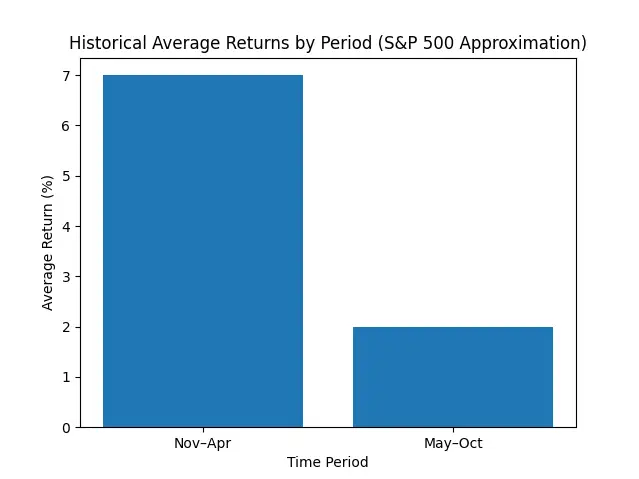
Source: Historical S&P 500 total return data (multiple studies including Fidelity, Stock Trader’s Almanac, and long-term market research). Returns are averages and do not reflect any specific time period or guarantee future results.
Some of us might now be asking ourselves if we should sell in May and go away! It is not a surprise that we view this strategy as trying to time the market – which is something we don’t recommend. Trying to move in and out of the market based on a date on the calendar introduces two major challenges: when to sell and when to get back in. It’s hard enough to be right once, much less twice. We also know that sitting on the sidelines can mean missing the rebounds which can and do happen quickly. And many of these have happened in the summer months.
So instead of selling in May and going away, we recommend a mid-year look at your
- Life changes – but don’t assume they are bad. There are many terrific life changes too!
- Risk tolerance – are you pacing the floor at night? Tell us if you are.
- Financial plan and cash flows – we can update with new information and new scenarios easily. Let’s do if there are significant changes.
Linder Financial Services is a dba of Thayer Partners LLC, (“Thayer”). Thayer is an SEC registered investment adviser. SEC registration does not constitute an endorsement of Thayer by the SEC nor does it indicate that Thayer has attained a particular level of skill or ability. This material prepared by Thayer is for informational purposes only. It is not intended to serve as a substitute for personalized investment advice or as a recommendation or solicitation of any particular security, strategy or investment product. Opinions expressed by Thayer are based on economic or market conditions at the time this material was written. Economies and markets fluctuate. Actual economic or market events may turn out differently than anticipated. Facts presented have been obtained from sources believed to be reliable. Thayer, however, cannot guarantee the accuracy or completeness of such information, and certain information presented here may have been condensed or summarized from its original source. Thayer does not provide tax or legal advice, and nothing contained in these materials should be taken as tax or legal advice.