Bernie’s Blog
Estate Planning 101
Thank you to all of you who joined our webinar last week. We want to share a few highlights about what we heard and how we are going to guide this process with all of you, whether you were able to join us last week or not.
- Our most important insight: EVERYONE ALREADY HAS A PLAN…. If it’s a plan that if we as family members haven’t written ourselves, the state has written it for us. So, the question isn’t whether there is a plan; it’s whether it’s the plan we want. And when life changes, the plan probably needs to change too.
Other insights:
- There are four common documents which define estate planning.
- Last will and testament
- Revocable trust (may not be required)
- Financial power of attorney (ends at death when executor takes over)
- Advance healthcare directive/healthcare power of attorney (may also require HIPAA authorization)
- We should have beneficiary designations for our investment accounts and annuities. These designations often supersede our wills, so they need to be correct and updated as needed.
- Moving real property (your house) into a Trust can be useful in some situations. This can be a complicated process. Laws vary by state.
- Taxes matter. And holding assets in a trust does not make income, estate or gift taxes go away. The type and structure of the trust determine the tax treatment.
- The tool we use helps facilitate the preparation of documents and can help you create estate planning documents from scratch or build on what you already have. A pre-meeting worksheet is used to establish your goals (the hard part) before the tool is even accessed.
- There are times when an attorney is needed and we can help connect you at a pre-negotiated rate when appropriate.
- We are here to guide you through this process. There is no additional fee from us to do this.
- We are ready to begin this work with you and those you care about!
Linder Financial Services is a dba of Thayer Partners LLC, (“Thayer”). Thayer is an SEC registered investment adviser. SEC registration does not constitute an endorsement of Thayer by the SEC nor does it indicate that Thayer has attained a particular level of skill or ability. This material prepared by Thayer is for informational purposes only. It is not intended to serve as a substitute for personalized investment advice or as a recommendation or solicitation of any particular security, strategy or investment product. Opinions expressed by Thayer are based on economic or market conditions at the time this material was written. Economies and markets fluctuate. Actual economic or market events may turn out differently than anticipated. Facts presented have been obtained from sources believed to be reliable. Thayer, however, cannot guarantee the accuracy or completeness of such information, and certain information presented here may have been condensed or summarized from its original source. Thayer does not provide tax or legal advice, and nothing contained in these materials should be taken as tax or legal advice.
Mid-Year Financial Check-Up
For most of us, it’s too hot to do anything outside, so it seems like a perfect time for a quick mid-year financial checkup.
We will just focus on a few of the highest impact items here. We can help with any or all!
Do I have a cash reserve in a high yield savings account and is it enough?
Ask yourself:
- Have my monthly expenses increased?
- Have I changed jobs or retired?
- Have I recently purchased a home or welcomed a new family member?
- Do I anticipate any major expenses before year-end?
- Have I used a significant part of my cash reserve without replenishing it?
Am I on track to maximize my employer sponsored retirement plan (401K/403B/457) while there is still time to adjust?
Check:
- Is my cash reserve well-funded? See above.
- Am I receiving the full employer match?
- Am I possibly overfunded or underfunded due to a bonus or salary increase?
- 2026 contribution limits (not including employer match):
- Up to age 50: $24,500
- Age 50 to 60: $32,500
- Age 60 to 63: $35,750
Are my beneficiaries up to date?
-
- Have I or my family members had a life event (good or bad) which make an update necessary?
- Did I just never get to adding/updating beneficiaries the last time I had a life event?
- Don’t forget to look at life insurance policies and HSA’s, as well as your investment and bank accounts.
- And while I’m at it, have I completed or at least progressed my estate plan?
Am I appropriately planning for my April 2027 tax bill?
Let’s discuss:
- Estimated tax payments
- Roth conversion
- Capital gain management
- Charitable giving strategies
- Medicare IRMAA planning if you’re approaching age 65 or already enrolled
- Am I taking advantage of eligible Traditional or Roth IRA contributions?
- Have I taken RMD’s from my non-Schwab accounts?
Linder Financial Services is a dba of Thayer Partners LLC, (“Thayer”). Thayer is an SEC registered investment adviser. SEC registration does not constitute an endorsement of Thayer by the SEC nor does it indicate that Thayer has attained a particular level of skill or ability. This material prepared by Thayer is for informational purposes only. It is not intended to serve as a substitute for personalized investment advice or as a recommendation or solicitation of any particular security, strategy or investment product. Opinions expressed by Thayer are based on economic or market conditions at the time this material was written. Economies and markets fluctuate. Actual economic or market events may turn out differently than anticipated. Facts presented have been obtained from sources believed to be reliable. Thayer, however, cannot guarantee the accuracy or completeness of such information, and certain information presented here may have been condensed or summarized from its original source. Thayer does not provide tax or legal advice, and nothing contained in these materials should be taken as tax or legal advice.
Is Anyone Else Often Baffled by the “Technology Ecosystem?”
As headlines continue to tout technology as one of the key drivers of economic growth now and in the future, we find ourselves wondering just what this technology ecosystem really is, how the pieces fit together and which companies participate in which part of this world. Since we are asking, we expect some of you are too.
The simplest explanation we found suggests that the technology industry is a pyramid. The growth prospects for each of these components can be different. See summary table below.
- The foundation is made up of companies which design and manufacture computer processing and memory chips.
- These are semi-conductor and computer chip firms.
- Computer chips are tiny pieces of semiconductor material.
- The next layer is companies which build devices and equipment of all types.
- These firms build the machinery needed to produce the semiconductors and the chips.
- Next are the actual device manufacturers.
- The devices are the pieces we use, like our Smartphones and computers.
- Networking/infrastructure is next layer.
- Next are computing cloud providers.
- These companies have massive data centers and rent computing power to businesses.
- There is a separate layer just for AI platforms
- The next layer has software companies.
- These run on the hardware and cloud infrastructure layers.
- And at the top are the cybersecurity companies which protect the networks and data.
Layer What These Companies Do Representative Public Companies Industry Growth Outlook AI & Processing Chips Perform AI calculations and computing tasks NVIDIA, Advanced Micro Devices, Broadcom Very Strong Memory Chips Store data used by computers and AI systems Micron Technology, Samsung Electronics, SK Hynix Strong Semiconductor Equipment Build the tools used to manufacture chips ASML, Applied Materials, Lam Research, KLA Corporation Very Strong Hardware & Devices Build computers, phones, and servers Apple, Dell Technologies, HP Inc. Moderate Networking & Infrastructure Connect data centers and businesses Cisco Systems, Arista Networks, Juniper Networks Moderate to Strong Cloud Computing Rent computing power and storage Microsoft, Amazon, Alphabet Strong Foundation Models (AI Platforms) Build AI and monetize (large language) models Anthropic, OpenAI, xAI, Google DeepMind, Meta AI Strong Software Create applications used by businesses and consumers Oracle, Salesforce, Adobe, ServiceNow Strong Cybersecurity Protect networks and data Palo Alto Networks, CrowdStrike, Fortinet, Zscaler Strong The technology ecosystem framework shown above is adapted from commonly used industry classifications and research published by MSCI/S&P GICS, Gartner, IDC, and the Semiconductor Industry Association. Company examples are illustrative and not recommendations.
What About Growth?
The biggest growth driver is artificial intelligence. AI requires advanced chips and massive data centers which has increased demand for semiconductor companies, chip manufacturers, chip equipment makers, AI platforms and cloud providers. Cybersecurity is also benefitting as companies become more digital. On the other hand, computers, smartphones, and basic networking equipment are likely to be slower growing areas.
Linder Financial Services is a dba of Thayer Partners LLC, (“Thayer”). Thayer is an SEC registered investment adviser. SEC registration does not constitute an endorsement of Thayer by the SEC nor does it indicate that Thayer has attained a particular level of skill or ability. This material prepared by Thayer is for informational purposes only. It is not intended to serve as a substitute for personalized investment advice or as a recommendation or solicitation of any particular security, strategy or investment product. Opinions expressed by Thayer are based on economic or market conditions at the time this material was written. Economies and markets fluctuate. Actual economic or market events may turn out differently than anticipated. Facts presented have been obtained from sources believed to be reliable. Thayer, however, cannot guarantee the accuracy or completeness of such information, and certain information presented here may have been condensed or summarized from its original source. Thayer does not provide tax or legal advice, and nothing contained in these materials should be taken as tax or legal advice.
- The foundation is made up of companies which design and manufacture computer processing and memory chips.
Who is Kevin Warsh and Why Should We Care?
Kevin Warsh is the new Chairman of the Federal Reserve, replacing Jerome Powell. He served as a Governor on the Federal Reserve Board from 2006 through 2011, during the global financial crisis. Prior to his nomination to this position, he frequently commented on monetary policy and inflation. We are almost all old enough to remember when we didn’t even know the name of the Chairman of the Federal Reserve, much less have any idea what this person does.
The Federal Reserve has a dual mandate to promote maximum employment and maintain stable prices. Simultaneously. The tools the Fed has at its disposal are important, but limited to
- Setting the target for the federal funds rate (interest rate banks charge each other for overnight loans)
- Buying and selling U.S. Treasuries (and sometimes mortgage-backed securities) to manage the money supply
- Providing forward guidance, which is sometimes more influential than that actual Fed actions – particularly to the stock market
Although the Chairman sets the agenda for the meetings and shares information and decisions, the actual fed funds rate is decided by a vote of 12 members of the Federal Open Markets Committee which is a sub-set of the Federal Reserve. So, although the Chairman’s words are important, he does not set the rate.
Next, let’s talk about what has changed and why it matters now.
No doubt that this is a challenging time for the Fed. Inflation has been stubbornly above the Fed’s 2% long-term target while the unemployment rate has risen, although it is still well below historical averages. Energy prices, tariffs, and geopolitical tensions have complicated the situation, but economic growth has been surprising robust.
Some experts have predicted that Warsh will favor an aggressive rate cut schedule because President Trump appointed him, while other Fed watchers expect that Warsh’s strong historical focus on inflation will be reflected in fewer rate cuts for the foreseeable future, with a possible hike before the year is over. These fiscal hawks also believe that Warsh will push for a faster reduction in the Fed’s balance sheet/more aggressive sale of Treasuries which will reduce the money supply and slow economic growth, all in the name of inflation management. For us as average investors, this likely means “higher for longer” rates which puts downward pressure on growth stocks and longer duration bonds.
Adding additional uncertainty is the expectation that Chair Warsh will be less likely to signal future policy moves in advance (forward guide) than Chair Powell did. Those Wednesday afternoon press conferences after Fed meetings may no longer be “must watch” TV. The question might become which thing markets dislike more – uncertainty or negative signaling. We may find out. Either way, volatility in bond yields and equity pricing might increase.
As we step back here, history suggests that although Fed Chairs can create short-term market unease, long-term market performance is rarely tied to a single Fed official, chairman or otherwise. So as usual, we are recommending discipline and planning, rather than trying to predict rate cuts.
And now Wednesday afternoons after Fed Meetings are available on our calendars for you, instead of for Fed chair press conferences. Sounds like a win to us.
Linder Financial Services is a dba of Thayer Partners LLC, (“Thayer”). Thayer is an SEC registered investment adviser. SEC registration does not constitute an endorsement of Thayer by the SEC nor does it indicate that Thayer has attained a particular level of skill or ability. This material prepared by Thayer is for informational purposes only. It is not intended to serve as a substitute for personalized investment advice or as a recommendation or solicitation of any particular security, strategy or investment product. Opinions expressed by Thayer are based on economic or market conditions at the time this material was written. Economies and markets fluctuate. Actual economic or market events may turn out differently than anticipated. Facts presented have been obtained from sources believed to be reliable. Thayer, however, cannot guarantee the accuracy or completeness of such information, and certain information presented here may have been condensed or summarized from its original source. Thayer does not provide tax or legal advice, and nothing contained in these materials should be taken as tax or legal advice.
Where Did “Sell in May and Go Away” Come from?
Happy May! Happy Mother’s Day! Happy Graduation!
We have all surely heard this old “sell in May and go away” saying, but probably never dug into where it actually came from.
Actually, this strategy is based on the simple historical finding that says that over long periods of time, stocks tend to perform better from November through April than they do May through October. Although the reason why the returns are lower is not confirmed, experts have suggested that it is likely due to the historically lower summer trading volumes in the U.S. and Europe.
Whatever the cause, the data are interesting and might be good cocktail party talk.
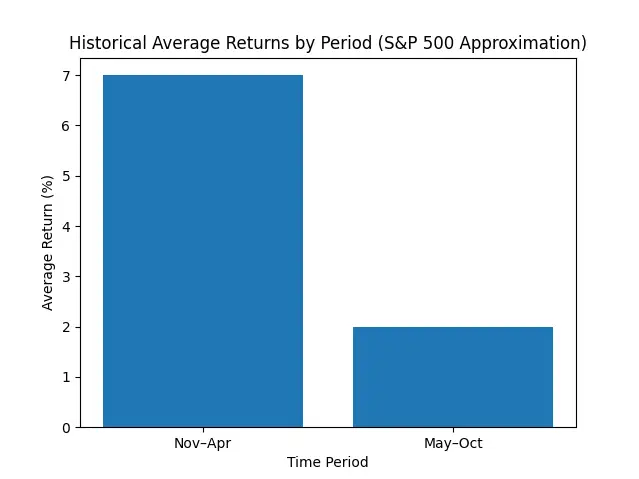
Source: Historical S&P 500 total return data (multiple studies including Fidelity, Stock Trader’s Almanac, and long-term market research). Returns are averages and do not reflect any specific time period or guarantee future results.
Some of us might now be asking ourselves if we should sell in May and go away! It is not a surprise that we view this strategy as trying to time the market – which is something we don’t recommend. Trying to move in and out of the market based on a date on the calendar introduces two major challenges: when to sell and when to get back in. It’s hard enough to be right once, much less twice. We also know that sitting on the sidelines can mean missing the rebounds which can and do happen quickly. And many of these have happened in the summer months.
So instead of selling in May and going away, we recommend a mid-year look at your
- Life changes – but don’t assume they are bad. There are many terrific life changes too!
- Risk tolerance – are you pacing the floor at night? Tell us if you are.
- Financial plan and cash flows – we can update with new information and new scenarios easily. Let’s do if there are significant changes.
Linder Financial Services is a dba of Thayer Partners LLC, (“Thayer”). Thayer is an SEC registered investment adviser. SEC registration does not constitute an endorsement of Thayer by the SEC nor does it indicate that Thayer has attained a particular level of skill or ability. This material prepared by Thayer is for informational purposes only. It is not intended to serve as a substitute for personalized investment advice or as a recommendation or solicitation of any particular security, strategy or investment product. Opinions expressed by Thayer are based on economic or market conditions at the time this material was written. Economies and markets fluctuate. Actual economic or market events may turn out differently than anticipated. Facts presented have been obtained from sources believed to be reliable. Thayer, however, cannot guarantee the accuracy or completeness of such information, and certain information presented here may have been condensed or summarized from its original source. Thayer does not provide tax or legal advice, and nothing contained in these materials should be taken as tax or legal advice.
Happy Financial Literacy Month
April is Financial Literacy Month – our favorite month of the year. Plus, we think everyone could use a bit of fun right now so it’s time for our annual financial literacy quiz.
When oil prices spike quickly and significantly, what is most likely to happen to the overall economy?
- Lower inflation
- Lower consumer spending
- Higher bond prices
- This is a dumb question because this will never happen
- No idea. I guess I need call LFS.
What happens to the cost basis of most inherited assets and why should I care?
-
- It stays the same as the original purchase price. My heirs will pay the same income tax I would pay if I sold.
- It resets to $0 so my heirs will pay taxes on the entire amount, not just the gain like I would pay
- It “steps up” to whatever the market value on my date of death so my heirs have no taxable capital gains at that time
- It is adjusted for inflation.
- No idea. I guess I need to call LFS.
When inflation rises unexpectedly, what usually happens to Treasury bond prices?
-
- Nothing
- They rise of course. That’s why I own them.
- They fall of course
- They become risk-free
- No idea. I guess I need to call LFS.
Which asset should I probably not transfer into my revocable trust during my lifetime?
-
- My Schwab brokerage/cash account
- My traditional IRA
- My primary residence
- My vacation home
- What is a revocable trust and why are we talking about it? I guess I need to call LFS.
What is my biggest long-term risk of holding too much cash?
-
- I will spend it
- My income taxes will go up
- My purchasing power will go down if there is inflation
- It’s harder to borrow money if I need it
- No idea. I guess I need to call LFS.
Linder Financial Services is a dba of Thayer Partners LLC, (“Thayer”). Thayer is an SEC registered investment adviser. SEC registration does not constitute an endorsement of Thayer by the SEC nor does it indicate that Thayer has attained a particular level of skill or ability. This material prepared by Thayer is for informational purposes only. It is not intended to serve as a substitute for personalized investment advice or as a recommendation or solicitation of any particular security, strategy or investment product. Opinions expressed by Thayer are based on economic or market conditions at the time this material was written. Economies and markets fluctuate. Actual economic or market events may turn out differently than anticipated. Facts presented have been obtained from sources believed to be reliable. Thayer, however, cannot guarantee the accuracy or completeness of such information, and certain information presented here may have been condensed or summarized from its original source. Thayer does not provide tax or legal advice, and nothing contained in these materials should be taken as tax or legal advice.